

WHERE AND HOW TO EXPERIENCE THE 2028 TOTAL SOLAR ECLIPSE IN AUSTRALIA AND NEW ZEALAND
There are few natural phenomena quite as extraordinary as a total solar eclipse.
As the Moon moves across the face of the Sun, shadows sharpen, temperatures fall, winds change, wildlife quietens and daylight fades. Then, for a few minutes, the Sun disappears entirely behind the silhouette of the Moon and the landscape is plunged into an otherworldly darkness.
On Saturday 22 July 2028, this remarkable celestial event will sweep across Australia and New Zealand, creating an exceptional opportunity to experience totality against some of the Southern Hemisphere’s most spectacular landscapes.
For travellers, the eclipse offers far more than a few extraordinary minutes beneath a darkened sky. It is an invitation to venture into the remote reaches of the Kimberley, discover wonderful wine country, experience Sydney Harbour in an entirely new light, or journey into the dramatic mountains and fiords of New Zealand’s South Island.
WHAT IS A TOTAL SOLAR ECLIPSE?
A total solar eclipse occurs when the Moon passes directly between Earth and the Sun, completely blocking the Sun’s visible face for observers within a relatively narrow corridor known as the path of totality.
During totality, the sky darkens dramatically and the Sun’s outer atmosphere, the corona, becomes visible as an ethereal halo around the Moon.
It is this brief transformation of the familiar into something profoundly unfamiliar that makes witnessing a total solar eclipse such a memorable experience.
WHEN IS THE TOTAL SOLAR ECLIPSE OVER AUSTRALIA AND NEW ZEALAND?
The total solar eclipse will take place on Saturday 22 July 2028.
The eclipse passes over Western Australia around 11am where the length of the total eclipse peaks at just over 5 minutes. The Moon’s shadow then travels east across the continent, descending Sydney into darkness (for just under 4 minutes) around 2pm local time.
Across the Tasman, totality reaches New Zealand’s South Island later in the afternoon. Queenstown will experience maximum eclipse at approximately 4.15pm (with just under 3 minutes of totality).
While the full period of the eclipse, from its first partial phase to its conclusion, lasts more than two hours, it is those precious minutes of complete darkness that eclipse travellers cross continents to experience.
WHAT MAKES THE 2028 TOTAL SOLAR ECLIPSE SO SPECIAL?
Accessibility.
The path of the 2028 eclipse passes across an unusually enticing collection of destinations for luxury travellers, from Western Australia’s remote Kimberley wilderness to emerging wine destinations and right over Sydney, before continuing into New Zealand’s spectacular lower South Island over Queenstown and Dunedin.
These natural phenomena usually only present a once-in-a-lifetime opportunity. The last total solar eclipse to pass directly over Sydney was in 1857, the next, not until 2858!
WHERE TO SEE THE 2028 TOTAL SOLAR ECLIPSE?
The best location will depend on how you want to experience the eclipse. For some, that means maximising the duration of totality and seeking wide horizons and favourable weather conditions. For others, it is about pairing the celestial spectacle with exceptional food and wine, wilderness, wildlife or a particularly memorable backdrop.
Here are some of our favourite places to consider.
CHRISTMAS ISLAND
One of the first Australian destinations to experience totality will be splendidly remote Christmas Island, where maximum eclipse occurs at approximately 9am local time.
Closer to Indonesia than mainland Australia, this tiny island in the Indian Ocean feels genuinely off the beaten path. Its intriguing mix of cultures is matched by remarkable natural beauty: technicolour coral reefs, superb diving and snorkelling, tropical rainforest, secluded beaches, waterfalls and dramatic coastal lookouts.
Almost two-thirds of the island is protected as national park, making this an appealing choice for travellers who prefer their eclipse experience with a generous dose of adventure. Birdwatching, deep-sea fishing, rainforest walks and 4WD explorations can all be woven around the main event.
WESTERN AUSTRALIA’S KIMBERLEY REGION
For wilderness on an altogether grander scale, few destinations compare with the Kimberley.
Ancient escarpments, immense skies and seemingly limitless horizons create a spectacular natural amphitheatre for the eclipse. July also falls within the region’s dry season, making the Kimberley an especially compelling option for eclipse travellers with the high likelihood of clear blue skies.
Along the Kimberley Coast, some of Australia’s most remote landscapes are best explored by expedition vessel or private charter superyacht, travelling between soaring cliffs, secluded bays, waterfalls and extraordinary tidal landscapes.
Inland, the Kimberley presents an entirely different canvas: immense cattle stations, boab-studded plains, ancient outback ranges and extraordinary geological formations; best explored by private charter aircraft, helicopter or 4WD.
With accommodation in the region already limited by its boutique nature, luxury lodges and expedition cruises are already attracting significant interest and this is one destination where planning well ahead is particularly important.
From Western Australia, the Moon’s shadow continues diagonally across exceptionally remote swathes of the Northern Territory and Queensland before reaching New South Wales.
ORANGE
Just over three hours west of Sydney, Orange combines cool-climate wine country with beautiful rolling countryside, sophisticated dining and an increasingly impressive collection of boutique accommodation.
Vineyards roll gently across the wide country landscapes, while ancient Gaanha bula (Mount Canobolas), steeped in local First Nations’ significance, rises majestically to offers sweeping 360-degree views. Travellers with an interest in the skies will find the short detour via Parkes (home to ‘The Dish’ renowned for its part in relaying the television broadcast of the 1969 moon landing) particularly rewarding too.
MUDGEE
Approximately three-and-a-half hours northwest of Sydney, Mudgee has retained the easy-going character of a country town while quietly establishing itself as one of New South Wales’ most appealing food and wine destinations.
Its surrounding countryside is dotted with boutique and family-owned wineries, many producing outstanding small-batch wines, while acclaimed restaurants make excellent use of the region’s abundant local produce.
BLUE MOUNTAINS
Only 90 minutes west of Sydney, the Blue Mountains feel considerably more remote than its proximity suggests. World Heritage-listed wilderness stretches across immense sandstone plateaux, deep valleys and eucalyptus forest, punctuated by waterfalls, walking trails and dramatic escarpments. Character-filled mountain villages perch along the clifftops, providing an atmospheric base from which to explore.
For eclipse travellers, it is the combination of accessibility and wilderness that makes the region so intriguing: a celestial event experienced against one of Australia’s most recognisable natural landscapes.
SOUTHERN HIGHLANDS
South of Sydney, the Southern Highlands offers a gentler landscape of rolling green countryside, forests, pretty villages and elegant country estates.
This is a destination particularly well suited to travellers who like to combine nature with gastronomy. Wildlife encounters, private gardens, local producers, cool-climate wineries and destination dining can all form part of a relaxed country escape, with the eclipse providing an extraordinary centrepiece.
CENTRAL COAST
Just beyond Sydney’s northern fringe, the Central Coast is shaped by water and wilderness. Sparkling bays, beaches and waterways sit alongside pristine bushland, national parks and pockets of coastal rainforest. Its proximity to Sydney makes it wonderfully accessible, yet secluded coastal properties and private nature experiences can feel a world removed from the city.
For travellers drawn to the water, the eclipse presents an opportunity to consider private coastal viewpoints or time on the water, always with weather and safe viewing conditions in mind.
SYDNEY
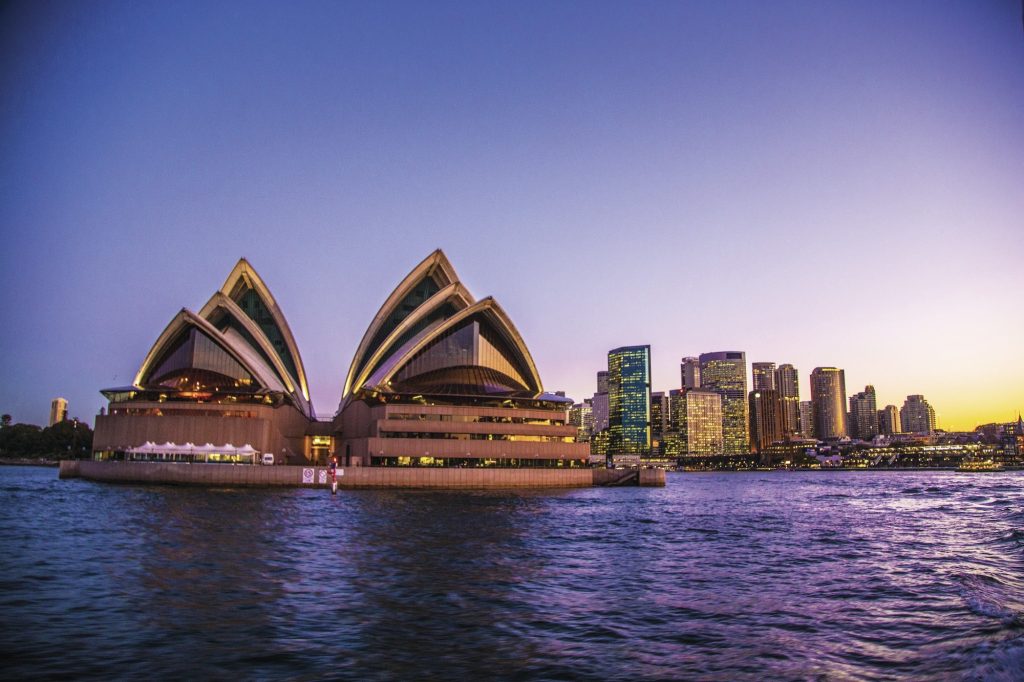
For sheer accessibility, and perhaps the most iconic backdrop of all, Sydney is difficult to surpass. The city sits within the path of totality, with maximum eclipse at approximately 2 pm and totality lasting a little less than 4 minutes.
Imagine the afternoon light fading over the harbour before the Sun disappears above a skyline framed by the sails of the Sydney Opera House and the iconic arch of the Sydney Harbour Bridge.
From private waterfront residences and harbour cruises to carefully selected vantage points around the city, Sydney offers an extraordinary combination of celestial drama and unmistakable sense of place.
NEW ZEALAND’S SOUTH ISLAND
After crossing the Tasman, the path of totality reaches New Zealand’s lower South Island.
QUEENSTOWN AND WĀNAKA
Few eclipse destinations combine accessibility, dramatic scenery and exceptional accommodation as effortlessly as Queenstown and Wānaka. Snow-capped mountains and deep blue lakes provide the setting, while accommodation ranges from sophisticated lakeside retreats to remote, exclusive-use high country mountain ‘huts’.
Southern Crossings can also curate spectacular private viewing possibilities in the surrounding mountains, using helicopters and specialist local knowledge to transform the eclipse into a much broader alpine adventure.
July is ski season in the region, making it easy to combine eclipse viewing with days on the slopes. The timing also falls shortly after Matariki, the Māori New Year (14 July 2028), providing another fascinating celestial dimension to a New Zealand winter journey.
DUNEDIN
At the southeastern edge of the South Island, Dunedin brings a wilder character to the eclipse journey.
Beyond its distinctive heritage architecture lies a dramatic coastline of windswept beaches, rugged headlands and wildlife-rich peninsulas. The wider region offers opportunities to encounter some of New Zealand’s remarkable marine and birdlife in beautiful natural surroundings.
Scientific or spiritual – from private introductions to astronomers and astrophotographers to First Nations and Māori perspectives on the night sky, private picnics, secluded wilderness settings, helicopter adventures and luxury cruising – Southern Crossings’ travel designers can pair this once-in-a-lifetime celestial event with experiences matched to your individual interests.
CAN YOU SEE THE 2028 TOTAL SOLAR ECLIPSE IF YOU ARE NOT IN THE PATH OF TOTALITY?
In short, yes, but the experience is very different.
Outside the path of totality, travellers will experience a partial solar eclipse, where the Moon covers part, but not all, of the Sun. This includes many popular destinations such as Melbourne and Auckland. While the partial eclipse will still be an impressive astronomical event, the sky will not enter the extraordinary darkness experienced inside the path of totality.
For anyone making a special journey to experience the 2028 eclipse, being within the path of totality is therefore an important consideration.
TOTAL SOLAR ECLIPSE VIEWING TIPS
Book well in advance
The eclipse is already generating considerable interest, particularly in destinations where accommodation and access are naturally limited. Kimberley lodges and expedition cruises, private vessels and specialist experiences have finite capacity, so early planning will provide considerably more choice.
Plan for the weather
No matter how carefully an eclipse journey is designed, cloud cover remains beyond anyone’s control. Choose your viewing location with the time of day and likelihood of good weather in mind.
Protect your eyes
During the partial phases before and after totality, it is unsafe to look directly at the Sun without appropriate solar viewing protection. Ordinary sunglasses are not sufficient. The eclipse should only be viewed through specialised eclipse glasses or handheld viewers. Only during the brief period of complete totality, when the Sun’s bright face is entirely covered by the Moon, is it safe to view the eclipse directly without solar filters. Cameras, binoculars and telescopes require appropriate solar filters.
Bring an extra layer
One of the most fascinating aspects of totality is how quickly the environment can change. Temperatures can noticeably fall as sunlight disappears, so an additional warm layer is worth keeping close at hand, particularly in Australia and New Zealand’s winter.
Make the eclipse part of a bigger journey
Totality may last only minutes; the memories surrounding it can last a lifetime. Spend the days beforehand cruising a remote coastline, tasting wine among the vines, skiing in the Southern Alps or exploring a World Heritage wilderness. The best eclipse journey is one that would be remarkable even without looking at the sky.
WHEN IS THE NEXT TOTAL SOLAR ECLIPSE VISIBLE FROM AUSTRALIA OR NEW ZEALAND?
A total solar eclipse over any one precise location is exceptionally rare, but Australia enters an unusual period of eclipse activity from 2028 onwards.
The 22 July 2028 eclipse is therefore both an extraordinary event in its own right and the beginning of an exciting period for travellers fascinated by the skies – with additional eclipses to follow in November 2030 (above the Eyre Peninsula and Flinders Ranges), July 2037 (over Western Australia’s , Uluru, Brisbane, Taupo and Hawkes Bay) and December 2038 over remote regions of Western Australia and South Australia, Victoria and the New South Wales South Coast; then Nelson and the lower half of New Zealand’s North Island.
For those hoping to experience the 2028 eclipse in Australia or New Zealand, however, the combination of accessible cities, remote wilderness, exceptional food and wine regions and some of the Southern Hemisphere’s most spectacular landscapes makes this particular event difficult to rival.
And now is the time to start planning.